A Quick Guide To Projector Screens
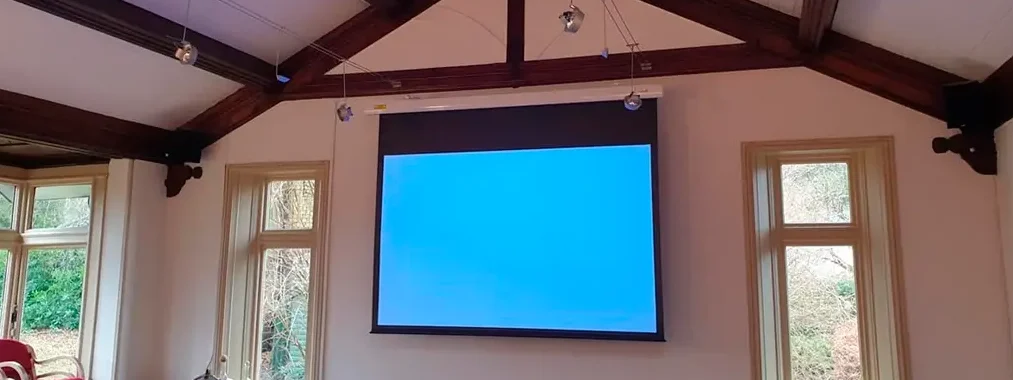
In today’s post, we will examine the various types of projector screens available and their respective applications. There are many varieties of projector screens, each with its unique features. Choosing the correct screen can make or break a successful projector installation. It is essential to take some time to think about the right solution.
1. Roll Down Manual Projector Screens
The roll-down projector screen is the most commonly seen. They are used extensively everywhere, from schools to home cinemas. They come in sizes ranging from 1.5 metres wide to around 3 metres wide. The size is generally limited on manual pull-down screens due to the mechanics of the screen and the comfort of operating it.
Manual screens have come a long way since the old days, and are no longer so cumbersome to use. At AV Installs, we prefer to provide premium slow-retraction screens. Just pull the screen down and pause; it will stay. To retract, simply pull the screen and release. The screen will slowly retract instead of being taken off and wound in.
Manual screens can be installed both on the wall and the ceiling, provided you are hitting ceiling joists or using threaded rod. Some manufacturers provide dedicated brackets that also allow for micro adjustments. The more budget friendly screens tend to have keyways for screws at either end of the screen.
2. Fixed Frame Projector Screen
Everyone is familiar with roll-down projector screens, but what are fixed frame screens, and what are they used for? Fixed frame projector screens are designed to be a permanent feature on the wall. The principle behind them is to pull the screen fabric tightly within a decorative steel frame. So what’s the point? The screen fabric is pulled perfectly flat and will never fold or crease. This is absolutely essential if you are investing in a high-end home cinema projector system. We also recommend them for commercial applications where dense text or highly detailed images are projected. They work very well for architects or designers who require highly accurate, detailed presentations for clients.
Fixed frame screens come in all manner of sizes and formats, catering for all projector resolutions. The frame is constructed first, typically consisting of four sections with corner braces that secure them together. There is a rail keyway on the inside of the frame with fixings for the screen to attach to. Rubber stretcher bands slide through eyelets on the edge of the screen and attach to the fixing on the keyway. The screen is pulled taught, and any folds or creases will vanish.
If you are doing this at home, please make sure there are two of you to lift the screen once it is constructed. Some manufacturers use hard plastic and nylon corner braces that don’t withstand the twisting of the screen when lifting it. It’s essential to raise the screen equally on both sides to avoid any trapezoid effect.
3. Electric Projector Screens
Electric projector screens come in a few flavours, depending on size and the decorative finish. The basic electric screen is just a motorised version of a manual screen. They all come with a rocker switch and can be integrated into third-party screen controllers. Some manufacturers have built-in remote control systems, while others don’t and leave it open for integration into larger control systems.
Electric Projector screens are available in all sizes and shapes at AV installs. The largest we have installed is 8 metres wide. As a general rule of thumb, screens above 4M should be tab tensioned. A tab-tensioned projector screen is almost a hybrid of a fixed-frame screen and an electric roll-down screen. There are metal cables on either side of the screen that go down with it and pull the edges tight. This prevents a lot of the curling on the edges of the screen, which is a big problem with large-format screens. Tab-tensioned screens are mounted using dedicated wall brackets in the same way as a normal electric screen. Tab tensioned screens are considerably heavier than normal electric screens. We would always advise contacting a specialist installation company like ourselves.
The last flavour of electric screen is the recessed variety. We have installed numerous recessed projector screens over the years, and they truly provide the ultimate solution. The canister and all the mechanics are recessed into the ceiling with only a trim kit visible when the screen is retracted. These are used extensively in home cinema installations and commercial solutions where the aesthetics of the room are paramount. Controlled by a remote control, 12V trigger or RS232, they can be easily integrated into broader systems.
Whatever your projector screen requirements are, AV Installs is here to offer advice and services to assist customers in getting the best solution for their needs. We can supply any screen type and size, as well as execute any installation service that is required. Get in touch today and speak with the projector screen experts!
Latest blog posts
Hello everyone, In addition to adding new speaker connection plates to the range this year, we have made some fantastic updates across our entire range of wall plates.
I wanted to take this opportunity to update everyone on the changes and new additions.
Dolby Atmos
Dolby Atmos is a revolutionary audio technology that...
Read More
AV Guides, AV Product Reviews, AV Products, Home Audio Visual Installation Projects
November 18, 2025
The Ultimate TV Wall Mounting System
What is the ultimate TV Wall Mounting system?
The Ultimate TV Wall Mounting System has arrived, and it's changing the way we install televisions. This innovative system is designed to provide in-wall storage for auxiliary devices behind the wall-mounted TV, providing a sleek, sophisticated look in any room.
The system consists of...
Read More
AV Guides, AV Product Reviews, AV Products, Home Audio Visual Installation Projects
October 21, 2025
Samsung Frame TV Mount Adaptor
Are you struggling to mount the Samsung 32" Frame TV on a Standard VESA wall mount?Firstly, the Samsung 32" Frame TV does not have standard VESA-compatible mounting holes on the back of the TV. This makes it very difficult to wall-mount on most standard articulated TV Wall brackets.The answer is...
Read More
AV Guides
September 18, 2025
How To Pair A Venset TV Lift Remote RF
Guide on how to pair a Venset remote control.Have you lost your Venset TV Lift remote?Are you looking for a new remote and need help pairing it with the Venset control box?The following guide and video have been put together to help customers pair a new Venset remote to the...
Read More
AV Guides, AV Product Reviews, AV Products
September 3, 2025
Speaker Connection Plates Guide
A Complete Guide to Installation and Benefits of Speaker Connection Plates
Have you ever tripped over a rogue speaker wire while reaching for the popcorn? Or you've meticulously arranged your furniture, only to have the illusion shattered by a tangled mess of cables snaking across the floor. We've all been there...
Read More